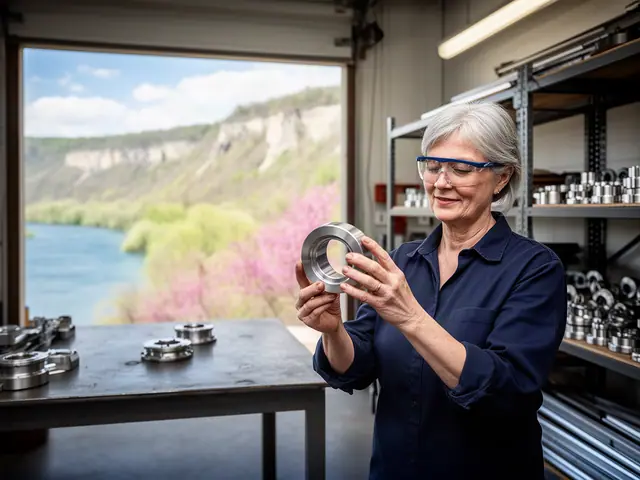
Glenpoint Finance, a small-business funding service in Dubuque, Iowa, covers funding for machine shops and metal fabricators: CNC machine and welder financing, loans to buy machinery, working capital for material and payroll on long customer terms, and setting up a new shop. Dubuque County NAICS 332 counts from CBP 2023 are included.
| Metal fabricators and machine shops with payroll, Dubuque County, IA | 41 establishments (CBP 2023) |
|---|---|
| Employees | 2,061, with $142.8 million payroll (CBP 2023) |
| Payroll across Dubuque County, IA manufacturing | $748.0 million (CBP 2023) |
Two money problems in a job shop
The first is capital equipment. A new or used CNC mill, lathe, press brake or laser is a large purchase with a long life, and it is the machine that wins the next contract. The second is working capital. A shop buys bar stock or plate, programs and runs the job, ships it, and then waits on the customer's payment terms. Larger customers may pay later. A shop growing quickly can run short of cash precisely because it is busy.
CNC machine financing options
CNC machine financing can be an equipment loan or a lease with the machine as collateral. Options include dealer or manufacturer programs, independent equipment finance partners, and term loans that bundle the machine with tooling and installation. Used machines from dealers or auctions can be financed; partners want the control type, year, spindle hours where known and an inspection report. The CNC machine loan calculator shows how price, down payment, rate and term set the payment, and the equipment financing page covers loan versus lease.
Can you finance a welder or a welding machine?
Yes. A welding machine, positioner, fume extractor or a robotic welding cell can be financed like any other equipment. A single welder is a small enough purchase that some shops pay cash or use a credit line; a robotic cell is a long-term equipment loan.
Business loan to buy machinery, compared
| Need | Often fits | Notes |
|---|---|---|
| CNC mill, lathe, brake or laser | Equipment loan or lease | Machine secures it; tooling sometimes included |
| Steel, tooling and payroll on a large PO | working capital | Repaid when the customer pays |
| Building expansion or a second bay | Term loan | Pair with a permit check first |
| Recurring gaps on net-60 terms | Line of credit | Draw per order, repay per invoice |
How to set up a machine shop
A new shop needs the space first: power (sometimes three-phase), floor load for heavy machines, compressed air and zoning that allows industrial use. Check zoning and permits before signing a lease; the Dubuque zoning and building permits guide explains where to ask. Then the first machines, CAM software, inspection tools and enough working capital to carry the first few jobs to payment. A partner may weigh a used-machine request for a new shop differently when the owner has run a shop before or brings a signed customer order.
What partners review for machine shops
- Bank statements and, for larger requests, two years of tax returns
- Machine quotes with serial numbers, year and condition
- Customer purchase orders and payment terms
- Receivables aging, showing who owes what and for how long
- Any machine already under a loan or lease
Illustrative example: a used five-axis machine
Illustrative only, not an offer. A shop buys a used five-axis machining center for $185,000 with $18,500 down and finances $166,500 over five years at a rate of 9.5 percent: about $3,500 a month. A customer offers a contract worth $22,000 a month but pays on 60-day terms, so the shop also needs about two months of material and labor up front. That second need is working capital, not part of the machine loan.
Customer concentration and what partners make of it
A job shop can depend on a handful of OEM customers. When one customer is half of sales, a partner sees two things: a reliable source of work, and a single point of failure. Expect questions about how long the relationship has lasted, whether there is a supply agreement, and what happens if that customer moves the work.
A signed purchase order or a multi-year supply agreement gives a partner something to read for a machine purchase. So does a list of customers by share of sales. If one customer dominates, ask each partner how it treats the concentration; a shorter term or a larger down payment may be discussed.
Metal shops in Dubuque County, IA
Dubuque County had 41 fabricated metal product manufacturers in 2023, the NAICS group that includes machine shops, with 2,061 employees and $142.8 million in payroll (County Business Patterns 2023). Only 24.4% had fewer than five employees, compared with 49.1% of all employer establishments in the county. Manufacturing as a whole paid $748.0 million, the largest payroll of any sector.
The county also had 34 machinery and equipment wholesalers and 15 commercial machinery repair firms with payroll (CBP 2023). The step-by-step in how to finance a metal or machine shop in Dubuque County goes further. Other industries are on the industries hub; county figures are on Dubuque County figures.
By Glenpoint Finance · Updated